WHO WE ARE
EXECUTIVE SUMMARY
About the organization: STAND FOR PEOPLE SUSTAINABLE DEVELOPMENT (SPSD) is a Non-Governmental Organization, established on 06 February 2018 and registered by the government of Rwanda under the Non-Governmental Organization Registration statute, Rwanda Governance Board (RGB) with a certificate of Legal Personality No 767/RGB/NGO/LP/11/2021).
Since its establishment, SPSD has been focused in promoting the formal and informal education for orphans and other vulnerable children, Empowering youth and young women with entrepreneurship skills, vocational trades to enable them to be innovative and competitive on job market, Providing special care to disabled people, people living with HIV, people with chronic diseases to allow them achieve their full potential and attain self-reliance.
Mission
The mission of SPSD is to promote the socio-economic conditions of orphans, unemployed youth, young women and disabled people for their self-reliance and to enable them to be aware of their rights.
Vision
The vision of SPSD is to improve the socio-economic wellbeing of the society.
Programs
- Education
- Livelihood
- Health
- Justice
- Environment
SPSD core values
Integrity- honestly serve the society and build confidence among beneficiaries, partners and peer organizations;
Compassion- Lovely serving the community and relieve the very needy;
Courage- Hardworking and patience until the results are obtained within the reasonable time;
Stewardship- Manage resources responsibly and creatively to benefit present and future generations
Target groups
Orphans and other marginalized children
Youths and single mothers
Disabled people, people living with HIV, people with chronic diseases
The following are the strategic objectives:
- Promote formal and informal education for orphans and other vulnerable children
- Empower youths and single mothers with entrepreneurship skills, vocational trades to enable them to be innovative and competitive in job market.
- Provide special care to disabled people, people living with HIV, people with chronic diseases to allow them achieve their full potential and attain self-reliance
With the strategic objectives above, the following are the cross-cutting activities:
- Mobilize orphans, youths, single mothers and disabled people to fight HIV/AIDS
- Mobilize orphans, youths, single mothers and disabled people to fight drugs usage
- Inform orphans, youths, single mothers and disabled people about law and their rights.
- Mobilize orphans, youths, single mothers and disabled people to subscribe to community-based health insurance.
- Provide information, knowledge and skills about hygiene, sanitation and nutrition to children, youths, single mothers and disabled people.
- Provide information, knowledge and skills about environmental protection and disasters preparedness and mitigation.
SPSD STRUCTURE’S OPERATIONAL STRATEGY
SPSD has implemented 2 projects in Rubavu District, Western Province/Rwanda; with those projects, SPSD returned to school 40 orphans and other marginalized children who had dropped out by providing them school uniforms, shoes and school materials;
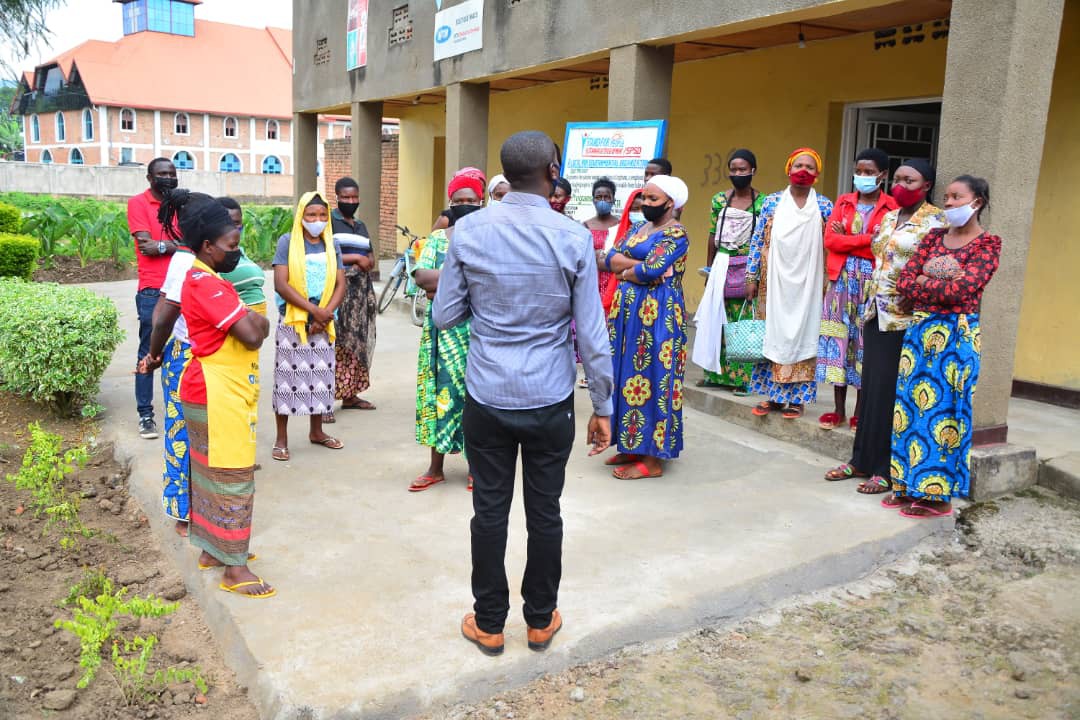
Under fund of the Embassy of the Federal Republic of Germany/Kigali, 30 teenage mothers and adolescent girls have been trained on the entrepreneurship skills, financial literacy, Health reproductive, cooperative management, Leadership and good governance. Among them, 25 are running the small cross border trade activities and 5 are running the vocational development activities of Hairdressing. SPSD has provided 30 livestock (sheep), one in each beneficial family of the project, 2 chickens and 1 kitchen garden was cultivated.
Currently, SPSD is implementing a project called “Great Lakes Youth network for Dialogue and Peace” Our Diversity our Opportunity which targets 100 existing youth actions and youth initiatives in Rwanda, Tanzania, DRC and Uganda who do valuable voluntary, peace building work in fields that such as gender equality, environment and climate change, political representation, democracy and good governance, land and inheritance, economic stability and employment, media, education, culture and religion and forced migration.
Overall Program Management
The Executive Director of SPSD acts as Chief Budget Manager for all projects implemented by the organization. S/he ensures that projects are managed in accordance with GoR laws, regulations and instructions related to the management of public funds and properties, taking into account the specific donor-grant agreement terms and conditions tied to the grant. At the level of SPSD there is a senior management team composed of the Executive Director, Finance and Administration Manager, Programs Manager and 2 filed Officers. The team ensures that the project is implemented on time with high quality standards and that project objectives are achieved.
Financial management, execution, control and reporting are performed according to current laws and government rules and regulations as well as the donor’s compliance. The management of staff is in accordance with Law N° 13/2009 of 27/05/2009 regulating labor in Rwanda. The organization ensures that the terms of the grant agreement signed between the donor and SPSD are respected.
Coordination of Activities
SPSD closely cooperates with all politico-administrative entities at the central and decentralized levels. The District labor Unit, the District JADF (Joint Action Development Forum), they play a key role in community mobilization activities, needs assessments, studies, communication of findings as well as capacity building interventions.
Interaction with District Authorities, JAF and Sector Authorities
SPSD as member of the District Joint Action Development Forum (JAF) seeks guidance and orientation, to ensure that interventions are aligned to District priorities, performance plan, strategic areas, and local environment. SPSD attends quarterly JAF meetings where it presents its interventions, plans, achievements and share best practices with other district development partners, as well as seeks corrective solutions to any common challenges. SPSD works with the local authorities to conduct trainings of beneficiaries, to plan and implement different projects and conduct close follow-up of activities. Sector authorities are involved in the identification and selection of socio-economically vulnerable people to be included in the Program.
MONITORING AND EVALUATION PLAN
Monitoring and evaluation guidelines is a central to the project’s monitoring and evaluation work as it provides guidance on how to define and measure effect and impact-level indicators to know whether or not interventions are making changes in people’s lives. These is the basis for developing a functional and participatory monitoring and evaluation system that encourages self-assessment, innovation and flexibility, active reflection, learning, planning and good decision-making.
Project monitoring is carried out jointly with other stakeholders, local government, communities and participants throughout the project implementation. Monitoring data are used to compile regular progress reports that are submitted to the Government body and the donor. Key partner staff is trained on monitoring and evaluation concepts and systems and is sensitized on the importance of M&E to program development. This facilitate systematic data collection and analysis and documentation of project achievements from which lessons learnt will be drawn and incorporated in future program and policy development.